
Article
General zoning plans and biomethane investments. How not to close the door on investors?
Poland has significant biomethane potential, but the future of many projects will be decided not only by technology, financing or feedstock. Spatial planning matters more and more — municipal master plans now decide where biomethane plants can be built.
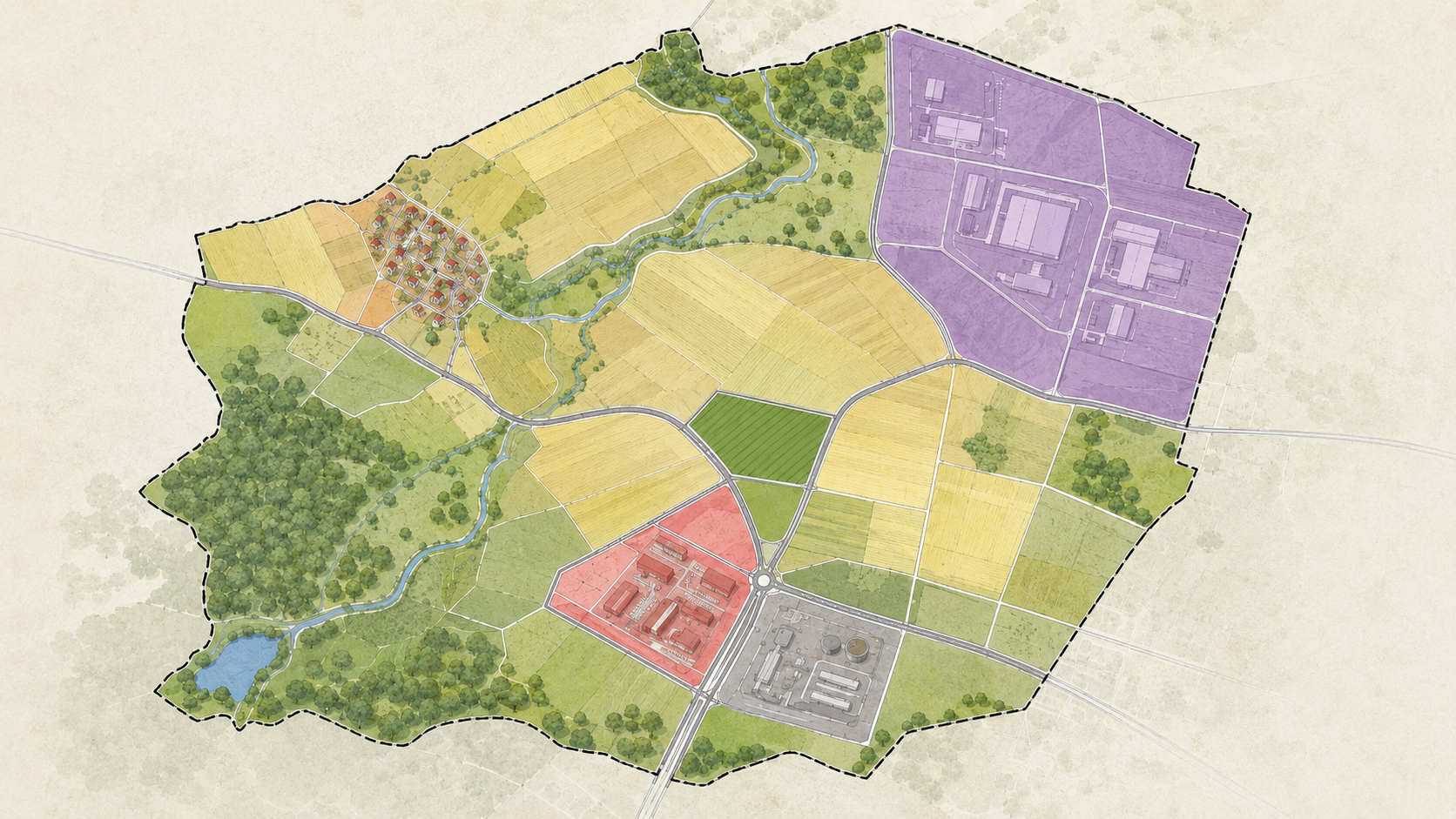
Poland has significant biomethane potential, but the future of many projects will be decided by more than access to technology, financing or feedstock.
Spatial planning will matter more and more. The master plans that municipalities are preparing today may decide whether modern biomethane plants can be developed in a given area in the future — or whether that option will effectively be closed off at the planning-document stage.
A biomethane plant needs specific site parameters
From the investor's perspective, the right plot is fundamental. For a modern biomethane plant the optimal plot size is about 4 ha.
Plot and distance from housing
- Optimal plot size: ~4 ha.
- Typical distance from residential buildings: 350–500 m. Polish law does not set a single fixed minimum distance for biomethane plants from housing.
Built-form parameters
For an industrial-energy facility, what matters most is the right built-form intensity, a biologically active area share of ~20%, and room for technical, process and transport infrastructure.
- Built-form intensity suitable for an industrial-energy facility.
- Biologically active area share: ~20%.
- Room for technical, process and transport infrastructure.
Access to the gas grid
The second key element is access to the gas grid. Both distance and grid capacity matter. The lower the local capacity, the more the distance to the connection point matters.
- Preferred distance to the gas grid: up to ~5 km.
- Optimal grid capacity: at least ~500 m³/h.
- The lower the local capacity, the more important it is to be close to the connection point.
Logistics
The plant should have good road access — preferably one that avoids dense residential areas and gives direct access to a higher-class road.
A master plan is a decision about the municipality's future options
A biomethane plant needs a properly prepared site. This kind of investment cannot be located just anywhere — even if a municipality has the agricultural potential, local sources of biowaste and investor interest.
The specifics matter: plot size, built-form parameters, infrastructure access, transport organisation and proximity to a gas grid with adequate capacity.
The master plan should therefore not be treated as a tick-box document. In practice, it is a decision about whether the municipality keeps real options to host biomethane investments.
This material was also published on LinkedIn
Open on LinkedInRelated
The gas grid and biomethane development. What can Poland learn from France?
Poland has one of the largest biomethane potentials in Central Europe. Waste from farming, livestock and food processing could feed thousands of local plants producing renewable gas. Increasingly, the key questions are not about production technology, but about infrastructure: required gas quality parameters, local grid capacity and the cost of connecting to the gas system.

Biomethane: does "more expensive" Polish gas pay off more than imports?
Price is not the full bill — 5 takeaways from the Polish Biomethane Association report that change how we should judge biomethane economics versus imported natural gas.
Cooperation
Let's talk about biomethane
Investor, farmer, municipality or journalist? Reach out to our team.